Use these smart merchandising strategies to turn eco-conscious consumers into last-minute buys and turn your produce area into a jute bag conversion zone.
The Issue of the Forgotten Tote (And Why It’s Your Stores’ greatest Opportunity)
We’ve all seen it occur. A customer arrives at the checkout line with a shopping cart full of organic kale and farmer’s market aspirations. “Bag?” the clerk asks. The sheepish head shake begins. Someone forgets their tote, so those carefully chosen veggies—worth maybe $40—go unnoticed. Once more. Not only are sales down, but a sustainability pledge has been broken.
The truth is, though, that panic attack isn’t an issue. It’s a chance. An exceptionally excellent one.
Transactions are not the only thing that take place in the checkout area. It’s where ambition and remorse meet in a moment that opens your wallet. Customers have just enough cognitive burden left to make one more, satisfying choice since they are intellectually exhausted and exhausted. Here’s where jute bags—those sturdy, earthy, and incredibly beautiful totes—come in completely. Jute conveys superior eco-consciousness, in contrast to fragile polyester reusables that seem like an afterthought. It’s the canvas sneaker of bags: straightforward, genuine, yet nevertheless more stylish due to its long-lasting construction.
There is a limited window of opportunity for impulsive purchases at checkout; research indicates that it takes a buyer 3–7 seconds to make a decision after viewing a product. Your whole window is that. A philosophy lesson about plastic waste is not something you have time for. You require an instantaneous emotional and visual impact. And strategically merchandised jute bags provide just that.
Zone 1: The Priming Effect of Entry
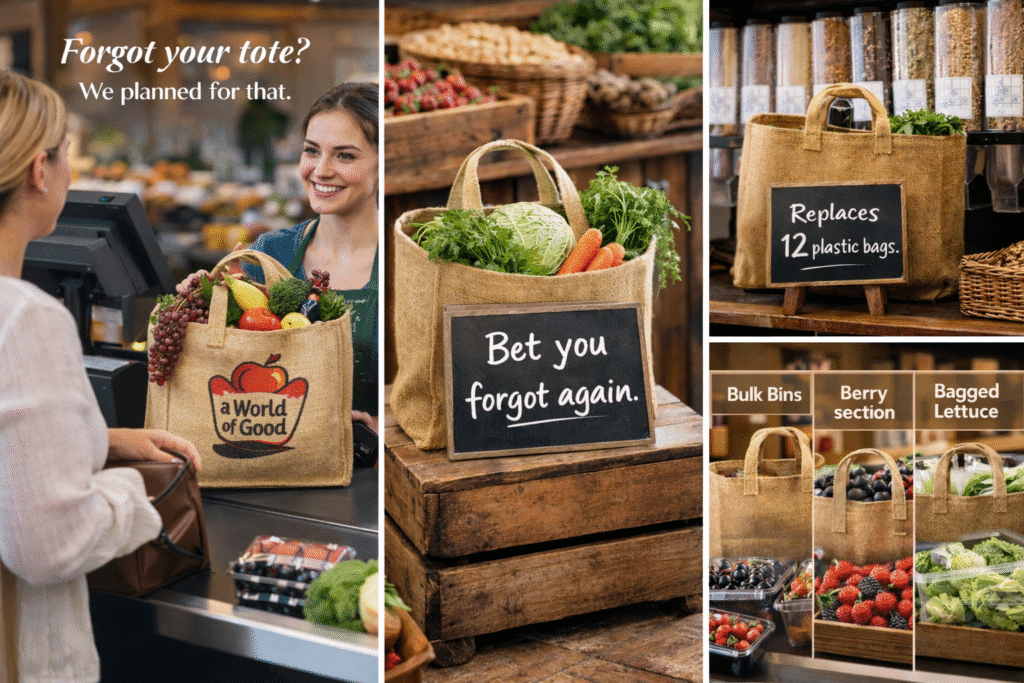
Plant the seed now rather than waiting till checkout. Place one well-designed jute bag at the door of your produce department. Not a rack. It’s not a bin. One bag, beautifully draped over a wooden crate, with the words “Bet you forgot again” written on a chalkboard.
This works because you acknowledge that forgetting is a common experience and provide a remedy before panic strikes. A glossy green cabbage should be visible in the bag, along with possibly some carrot fronds. Make it appear deliberate, as if it were purchased from a French marketplace. The objective is to make a mental bookmark, not to sell the bag here. That image remains in their brain, preparing them to be open to the real offer when they eventually hit the checkout button.
Why it works: Retail psychology has a wealth of evidence supporting priming effects. When a product is offered again, customers who have already seen it are more likely to buy it, especially when there is less time constraint (such as during checkout).
Zone 2: Positioning Trigger Points (The Satellite Approach)
This is where the majority of stores fall short. They gather all of their baggage at the checkout or entry. Satellite jute stations must be strategically placed at friction points, or times when environmentally concerned consumers are already uneasy.
Ideal sites:
Every eco-shopper’s soul kills a little when they purchase plastic in the bagged lettuce area.
Bulk bins: By aisle three, scooped quinoa is placed in a paper bag that will tear.
Where plastic clamshells seem like the enemy in berry displays
Every station receives precisely three bags. No more. Customers are more likely to make impulsive purchases when inventory seems limited because scarcity encourages this behaviour.
Assign a particular, pertinent sign to each station:
Bulk bins: “This bag eliminated the need for twelve plastic produce bags.” You’re really welcome.
Berry section: “The truth is that those clamshells are only useful once. It has more than 600 uses.
Lettuce in a bag: “You are aware that this plastic annoys you. Now fix it.
The language is important. It’s straightforward, even a little arrogant, but that’s exactly the way your client wants to feel. They are affirming an identity rather than merely purchasing a purse. Embrace that psychology.
Zone 3: Domination of the Checkout Lane (The Main Event)
The conversion takes place here. Turn your checkout lines into displays for jute bags.
Display plan:
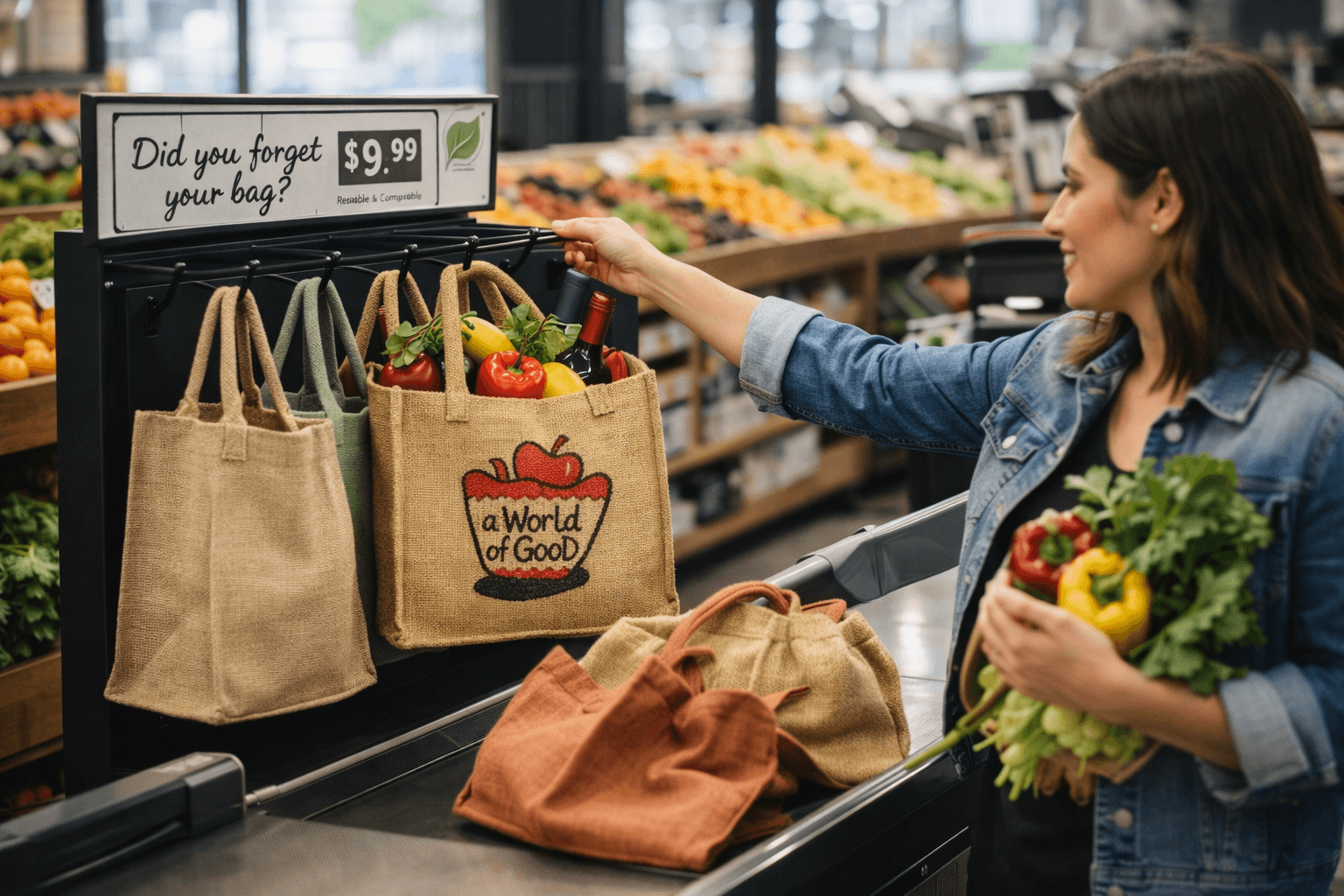
Lane divider hook strips (yep, those metal bars that people typically overlook): Put five bags—natural, olive, and terracotta—in a visual lineup with colour blocks. only at eye level. When people figure out their total, they don’t look down.
The hidden weapon of the cart corral: Put a big, benefit-driven tag on a single jute bag that reads, “Holds 30 lbs.” Watermelons were used for real testing. This serves as a visible reminder even before the checkout process starts.
The 15-second close, or the cashier moment:
Teach employees to identify the produce moment. “Want the bag that actually holds all this?” they ask as they see a conveyor belt full of produce. Then, and this is important, they give an example. Take the jute. Display the strength of the handle. To demonstrate durability, you might even store one filled with potatoes beneath the register.
It’s not a script. It’s a proof point that comes after a natural observation. When the bag performs in real time, it sells itself.
The Instagram Aspect: Add Visual Appeal. This will bring in a lot of younger Instagram demography to your store. Think new customers.
Plastic bags will never have the natural aesthetic appeal of jute bags. Make use of this.
Create displays using real vegetables as props, burlap backdrops, and natural wood boxes. Every time, a handmade chalkboard sign is superior to a printed sticker. The ‘e’ has a faint smear. That shows genuineness and concern.
Pre-stuff jute bags with lifestyle items as part of a bundle strategy
The “Farmers Market Starter Pack” comes with a bouquet of parsley, a lemon, and a recipe card.
“Summer Picnic Ready”: Combine herbs and stone fruit.
“Dinner Date Kit”: Provide a sneak peek at a cheese platter that pairs well with wine.
It’s a lifestyle promise now, not just a purse. Crucially, color-block your displays. Put olive bags with green broccoli and natural jutes with orange sweet potatoes. The bag becomes the trophy, and the produce becomes the exhibit.
Pricing: The Sweet Spot of No Regret
For impulsive purchases, price positioning is crucial.
Notes on Price Point Status in USA in USD$
$7.99 ✅ Ideal Impulse Threshold; seems more like an accessory than a significant investment
$9.99 ✅ Acceptable Still appealing on impulse; indicates a minor improvement in quality
$15.99 ⚠️ Pushing it Only works if the bag is obviously large or made of high-quality material.
$10.00 plus ❌ The buyer goes into consideration mode when the impulse is too strong.
Why $7.99 is effective: It is situated below the psychological cutoff point at which consumers transition from making emotional to logical purchases. It feels more like “found money” than a budgeted expense.
Use signs to anchor the value:
In six trips, it pays for itself. lasts more than 600 uses. (They can do this math as their child cries out for a candy bar.)
“Typical customer saves $47/year vs. single-use bags.” (Specific figure > ambiguous assertion)
Integration of loyalty (the immediate-reward model):
Purchase vegetables and scan the bag to receive an instant $0.50 discount today.
OR: Punch card system (five produce purchases = free sixth bag)
Immediate, not delayed, rewards are crucial. Impulse demands it now, not later.
Cross-Merchandise: The Unspoken Benefit
This is the point at which ecosystem thinking transcends bags.
Join forces with regional brands: Demo jutes are prepared with artisan cheese, small sourdough, and local honey. The bag turns into a tool for exploration. “What a thoughtful store,” the customer thinks as you simultaneously transition three product categories and cultivate brand loyalty.
Non-negotiable seasonal rotations:
Summer: Stone fruit and jute bags with “Beach picnic ready”
Fall: Place the bags next to the apples in a wheelbarrow and include a QR code that connects to the farm narrative.
Winter: Include a roasted recipe card and a bundle of root veggies.
Spring: Combine packets of herbs and seedlings.
Each spin connects the bag to a moment of lifestyle rather than merely a practical necessity.
Store Staff: Employees Are Your Secret Force of Sales
Produce workers and cashiers do not take orders. They work as salespeople. However, they require clarification.
Training (the practical version):
- Handling: Employees test the seams, feel the weight, and touch the bag. It’s true.
- Keep one laden with real weight (potatoes work) close to the register as a durability demonstration.
- The moment: Employees say, “This holds way more,” and give the jute to someone who packs produce in plastic. Not a query. A gentle recommendation supported by proof.
- Handling objections:
“It’s scratchy” → “That’s good quality.” It lasts and gets softer with usage.
“It’s too expensive” => “It takes six trips to recover at $4.99.” The majority of users utilize it more than 100 times.
Employee feedback loop: 10-minute check-ins every week. What are consumers saying? What objections are being raised? Make use of this to improve training and signage.
The 90-Day Implementation Roadmap
Weeks 1-2 of the 90-Day Implementation Roadmap: Install the checkout hooks, satellite stations, and entry display in three zones. Teach the 15-second demo to cashiers.
Staff feedback session, weeks three and four. What resonates? What’s collapsing? Based on actual objections, modify the signage.
Weeks 5–8: Implement the loyalty program. Track data from apps or punch cards.
Weeks 9–12: Examine the outcomes. Important metrics:
The percentage of produce-only baskets that are abandoned at checkout (before vs. after) is known as the produce abandonment rate.
Conversion of jute bags: The proportion of checkout transactions involving bags
Rate of repeat purchases: What percentage of buyers bring back the bag they purchased?
Movement across categories: Did packaged goods boost sales?
What Isn’t Effective (Take Note of These)
Before launching, steer clear of these typical blunders:
Twenty bags vying for attention at the entryway causes analytical paralysis. Limit your display to one that stands out.
Ignoring the quality of the material: Weak jute seems inexpensive. Purchase bags with reinforced handles; recurring purchases will cover the cost.
“Eco-Friendly Bags $4.99” is not apparent on generic signage. “Once more, you forgot. “Fix it for $4.99” stands out.
Staff tone and message mismatch: If your signage is cheeky but the staff delivers it in a robotic manner, it will all fall apart. Consistency in tone is important.
Employees in the produce area should start seeding jute bags at spots of friction before customers even get to the checkout.
Beyond the sales: Building Loyalty
The true benefit is that this isn’t about packing luggage. The goal is to become the business that addresses the issue of forgotten totes before they interfere with someone’s dinner plans.
Each jute bag that leaves your house serves as a little advertisement for your dedication to sustainability. Next week, when that consumer uses it at a rival store? You still have a victory. They will not return to plastic. You ensured that.
More significantly, they will return to your store. because you foresaw their need and made doing the right thing seem natural. The moat is that. Loyalty is that.
Checklist for Final Implementation
Installation of an entrance display (chalkboard, wooden crate, single bag)
Three satellite stations were set up (bagged lettuce, fruit, and bulk).
Color-blocked bags (5 bags, natural, olive, and terracotta) are attached to checkout hooks.
Completed cashier training (no scripts, 15-second demo)
Signs have been printed and put up at every station and location.
Setting up loyalty integration (punch card or app)
A timetable for staff input was developed (weekly 10-minute check-ins).
KPIs (abandonment rate, conversion percentage, repeat purchase percentage)
A 90-day review meeting is planned.
The Bottom Line
It’s not a cosmetic glow-up for the produce department. It’s a radical rethinking of how you address a genuine client issue and make money from it. When appropriately merchandised, jute bags serve as a link between ambition and action. Additionally, consumers return when they feel wise to spend money. Each and every time.
Bring that produce department to life. Make allegiance out of guilt. Because the best impulsive purchases are those that make individuals feel better about spending the money, rather than ones that happen on the spur of the moment.